Another Oncology Visit and “Not Being Good Enough”

(Title image: Photo by Nik on Unsplash)

“I see pharmacological interventions in your future” is a paraphrasing of what my oncologist told me at my last doctor’s visit.

So let me back up a bit. I had my “eight-years-since-finishing-chemo” appointment with my oncologist last week. Things went the way they’ve been going for a while. He was very pleased with how things have been going and that made me feel very positive.

Certainly, I have my share of stressors churning at the moment, but most of them are not health-related. Most.

When my oncologist reviewed my bone density reports, however, he made the same prediction that he has during my previous two visits with him (see his quote above). The issue is that my bone scan in 2019 showed osteopenia, which I have to say is pretty weird given my lifestyle, which includes a lot of strength training. We both thought that perhaps it was an issue with the way the numbers were calculated.

Unfortunately, my 2024 bone scan showed a significant loss of bone compared to 2019. Enough to really concern my oncologist and befuddle us both.

So despite my living the lifestyle that medical guidelines say I’m “supposed to” live in order to stay healthy and strong, it’s still not good enough.

Tried as hard as you could? Well, too bad, try harder.
(Photo by Mads Schmidt Rasmussen on Unsplash)

This harkens back to what I experienced after being diagnosed with breast cancer. It seemed like I had done everything I could to lessen my chances of getting cancer, including things that should have been protective, but there I was, a breast cancer patient, and a young one at that (which, I later learned, what one of the reasons the risk factors didn’t necessarily apply to me, but I didn’t know that at the time).

It drove my perfectionistic mind haywire.

It brought on feelings of helplessness and even despair.

The only thing that gave me a bit of a lift was learning to meditate. Meditation imparted a sense that I had a teensy bit of control, if not on the situation, at least in the way that I reacted to it.

I got through that period of my life, brushed myself off and went on. And for a while, I was feeling blessed.

But cancer treatments have long-term effects. And the repercussions of being pushed through menopause and being on endocrine therapy eventually caught up to me. Physical movements that used to be easy started to hurt. I lost muscle mass…and apparently, I lost bone too. I felt like I was treading water with a weight tied around me.

Never good enough.

So I am bearing down and reworking my diet and exercise program even more. And to be honest, this is also an opportunity to shed some of my perfectionistic tendencies. While I want to feel like I am doing everything I can to help stop my bone loss and avoid taking medication for it, I need to learn to give myself grace. Sometimes even doing everything “right” will not be 100% successful, and I have to be okay with that.

8 Year Cancer-versary and Everything Hurts

(Title image: Photo by Nick Fewings on Unsplash)

This past weekend marked eight years since my breast cancer diagnosis and I recently had another oncologist appointment.

Over the years my appointments have become lighthearted. This one was not so much.

While I was concerned about the migraine auras that I’d been experiencing in the fall of last year, my oncologist had called me in November 2024 with the results of my bone density scan: I’d lost more bone and was deeper in osteopenia.

To be fair, I don’t even know how much more. It had been strange to find myself labeled with osteopenia when I had my first bone density scan over five years ago. Neither my oncologist nor I could understand it. I live a very active life with frequent workouts, including a lot of strength training. By all accounts I should have strong bones. At the time, we figured it was something to do with algorithms applied to the bone density data and my bones were actually in better shape.

Ow, ow, ow, ow, ow!
(Photo by julien Tromeur on Unsplash)

This time around, it was worse. Since the first measurement, I’d had two years of tamoxifen and one of aromatase inhibitors. That didn’t help. But all the exercise? Did it not matter? Apparently not enough.

That was frustrating on its own. But to add to that frustration, I’ve been hit with injuries. My left shoulder, my left hip and most recently my lower back.

Each one of these has taken a toll on my exercise schedule and I will likely have to seek out physical therapy for at least the shoulder. At least. The hip I have been able to manage to a certain extent. Then I tweaked my lower back rowing about two weeks ago…I kept working out, more gingerly for sure…until I managed to re-tweak my back because apparently I am incapable of leaving things well enough alone.

On the bright side, the pain in my back made me completely forget the pain in my hip. Which is not to say that there is no pain, just that it pales in comparison to back spasms.

My oncologist offered to order a spinal scan for me. I graciously declined—I’m pretty darn sure it’s just my back muscles—but his concern is valid. If I’m lifting weights with increasingly porous bones, he’s worried about spinal compression fractures.

I guess he won’t have to worry about it now. I’ve been smacked in the face with a healthy dose of humility. No, I had no intention of pulling back on my workouts, but doing so is unavoidable. The amount of weight I can lift without injury has steadily decreased (injury by injury) and with this last helping of pain, I have to face reality. I need to completely rehaul my workouts along with my expectations.

Just sittin’ and chillin’ and dreamin’ of strong bones.
(Photo by Anne Nygård on Unsplash)

Perhaps most importantly, I need to not view this as a failure on my part. Because while I knew that eventually that day would come, I was not prepared to actually accept that it was here. I was still trying to “work my way back up” to where I was before, even when I knew that it was unrealistic.

After all, I remind myself, the fact that I need to adopt a slightly gentler approach to my workouts is a sign of success: the reason I need to be more careful now is because I have survived this long past my diagnosis. That’s not a punishment or a capitulation. It is, in fact, a blessing and a luxury that many cancer patients don’t have.

~~~~~~~~~~~~~~~~~~~~

What now? I am resistant to bone-building bisphosphonates at this time, for a variety of reasons (hello, side effects). I want to see if I can stop/slow the bone loss on my own. I have the exercise part down, no problem. But to be completely honest, my dietary intake of calcium was very low. I had every intention of supplementing with calcium after my first bone density scan, but got spooked by the potential for heart issues.

Since then, I’ve learned about the importance of Vitamin K2 and the Japanese fermented bean natto, which has loads of it and makes sure calcium gets to the bones instead of the heart. I’ve re-started the calcium supplements with a daily serving of the fermented stuff. You could say, I’ve become an aficio-natto.

And now that I am forced to back off the intense exercise, I have the opportunity to focus on mobility work, stretching and rehabilitation as I discover what body parts are going to need the attention of a physical therapist. We’ll see how this new approach to fitness works.

Aging Muscle: After Cancer Treatment and Menopause [PHOTOS]

(Title image: Photo by Samuel Girven on Unsplash)

This is a reality check to demonstrate how, even with the greatest of intentions and planning, coupled with a serious love of exercise, you can’t turn back time.

And that’s okay.

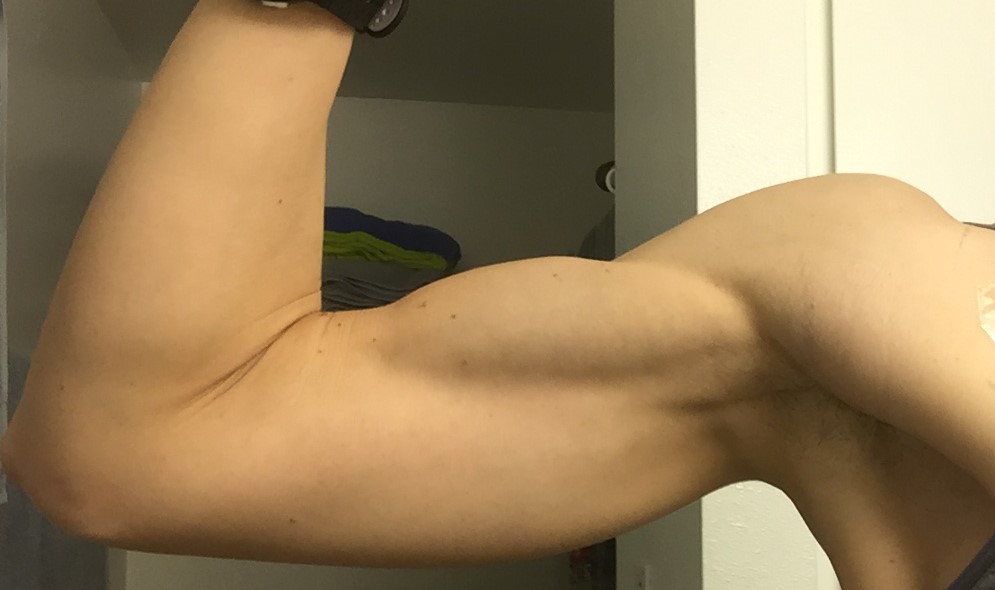
But first, the comparison. Taken from this previous post, here’s a photo right before I started chemotherapy for triple-positive breast cancer, April 27, 2017:

April 27, 2017: I was exercising with a vengeance

After finishing chemo, radiation and Herceptin, AND after two years of estrogen-lowering Tamoxifen and a year into Letrozole, I’d lost some muscle even though I was lifting as heavy as I could.

This photo is from December 11, 2020:

December 11, 2020: Still exercising with a vengeance, but…

While I was still working out hard, endocrine therapy and menopause took their toll on my progress. Interestingly, estrogen is not simply a “feminizing” hormone; in women, it also helps preserve both muscle and bone mass. Menopause puts the breaks on estrogen production.

This becomes worrying as we age because less estrogen means weaker muscles which can lead to a greater risk of falls and chance of bone fractures. Endocrine therapy, which is designed to decrease the estrogen in the body in order to lessen the recurrence risk of hormone-sensitive breast cancer, adds to the problem.

And more than seven years after the top photo, this was taken today before posting, September 23, 2024:

September 23, 2024: New phone, different lighting (sorry!), more wrinkles, same moles. I’m working hard just to keep what I have, but loss is inevitable.

I’m still lifting but the entire landscape of my workout routines has changed. I have to give myself more recovery time between strength training sessions. I am much more susceptible to injuries—seriously, I can tweak something by turning or stretching out in a weird way. I have neuropathy in my feet which makes getting up on my toes (such as in plank or doing lunges) painful.

We recently had an intense heat wave: for a week the temperature inside our apartment didn’t fall below 80F degrees, and during the day it climbed as high as 95F degrees (again, INSIDE our apartment). I managed to work out through a chunk of that week, but the heat eventually got to me. And recovering from that took almost another week.

So, the spirit is willing but the flesh is barely managing at times.

However, there is an upside to being 58 years old with a lifetime of fitness experience. I still love working out. Even tough training sessions are manageable because they feel like an awesome accomplishment, and I feel bouyed afterwards.

Even on the days that I don’t do a formal workout, I make sure that I’m moving as much as I can. Fitness is an integral part of my life, even though it looks different now than it did seven years ago. In the post that I reference earlier, at the very bottom I wrote about how yoga was becoming a larger part of my life.

And that’s continued. Through my yoga teacher training in 2022 and upcoming yoga4cancer advanced training starting in January 2025, this direction feels so right for me.

While I don’t plan to give up my gym sessions anytime soon, yoga has given me a path to physical and mental fitness as I age. I am gradually moving into a more meditative approach to exercise that is less about intensity and more about staying healthy by integrating mind and body.

yoga4cancer: Bringing the Benefits of Yoga to Cancer Patients and Survivors [VIDEOS]

(Title image: Photo by Zoltan Tasi on Unsplash)

In February 2022, I started a yoga teacher training program with a singular goal: to eventually teach yoga to cancer patients and survivors.

With its mix of physical postures (asanas), breathwork (pranayama) and meditation, yoga is ideal for someone going through the traumatic experience that cancer can be. Yoga can provide enough physical exertion to count as moderate exercise and the ability to help the practioner calm their mind, things that are so important for improving cancer treatment outcomes. However, classes must be designed carefully and taught thoughtfully.

Yoga4Cancer Q&A for Cancer Patients and Survivors (Yoga Alliance on YouTube)

Keep in mind, yoga teachers were yoga practitioners first. Many of them got really good at the practice, developed great flexibility and balance and gained respect for the tradition of yoga. But that doesn’t automatically make them appropriate yoga teachers for cancer patients, who need an instructor that understands the nuances of what cancer is and how treatment affects us.

A yoga teacher and breast cancer survivor by the name of Tari Prinster addressed that need by creating yoga4cancer (y4c), “an evidence-informed Oncology Yoga method tailored to address the specific physical and emotional needs left by the cancer and cancer treatments. The approach matches breath and movement to stimulate the immune system, improve flexibility & strength, reduce anxiety and boost overall well-being” (from the y4c website).

I’m planning to begin the y4c advanced 75-hour certification program (see informational video here) either later this year or early next. I’ve been so impressed by y4c’s emphasis on understanding the unique situation that cancer patients and survivors are in–it’s not just your garden variety beginner yoga class with “also for cancer patients” dressing. The program is well-thought out and comprehensive, and I’m so excited to embark on this next leg of moving closer to my teaching goal.

In the meantime, here is a selection of videos created by Tari and her instructors that are specifically geared for the mental and physical needs of cancer patients and survivors:

Yoga4Cancer Oncology Yoga for Cancer Related Fatigue (Yoga Alliance on YouTube)
Yoga4Cancer Yoga for Bone Loss (Yoga Alliance on YouTube)
Yoga4Cancer Yoga for Range of Motion (Yoga Alliance on YouTube)
Yoga4Cancer.com Yoga for Anxiety (Yoga Alliance on YouTube
yoga4cancer.com Yoga for Lymphedema (Yoga Alliance on YouTube)
yoga4cancer.com Yoga for Constipation (Yoga Alliance on YouTube)

Enjoy!